

When Clash of Clans Starts Punishing Players Who Don’t Have Time

A veteran TH17 player examines how Clash of Clans’ endgame has shifted from strategic challenge to time-driven pressure. From inefficient resource farming and frequent low-loot bases to league demotions caused by inactivity, the article argues that high-level progression increasingly rewards time availability over decision-making. It calls for design adjustments that preserve depth while making long-term play more sustainable for dedicated players.

Mini Event Pass
$2.72
$3.5-$0.78Event Pass
$3.87
$4.99-$1.12Gold Pass
$5.41
$6.99-$1.5880 Gems
$0.77
$0.99-$0.22




As a long-time player who has made it all the way to TH17, I’ve never thought of Clash of Clans as a “casual” game. It has always demanded planning, patience, and strategic thinking—and that’s exactly where its appeal lies.
Lately, though, I’ve felt a noticeable shift. The pressure no longer comes from executing attacks well, but from the amount of time the game expects you to commit every single day.
This isn’t about the game “getting harder.”
It’s about the game quietly turning into a time-management test.
From Strategic Challenge to Time Burden
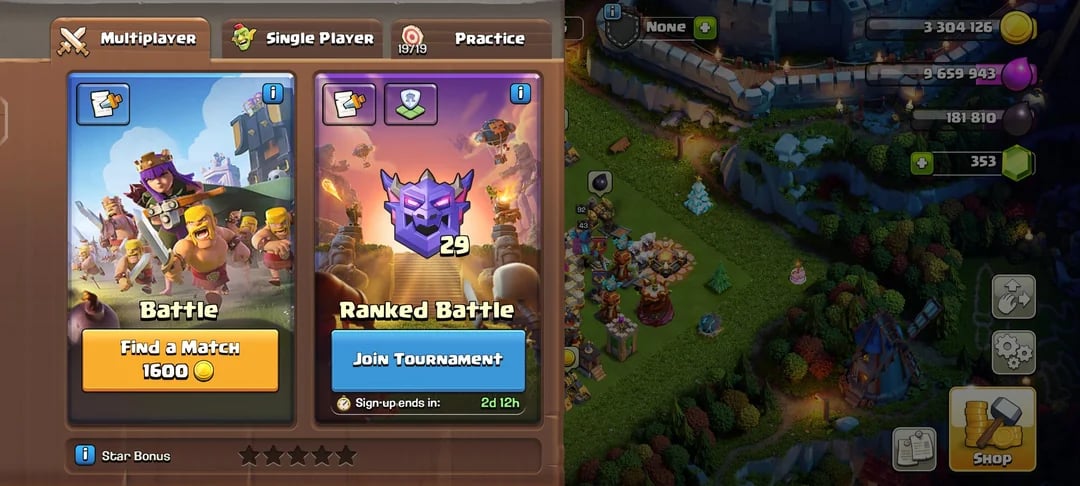
On paper, 5–8 attacks a day doesn’t sound unreasonable. But when real life gets busy, that number quickly turns into a burden. You don’t open the game because you want to attack—you open it because you feel like you can’t afford not to.
At high Town Hall levels, attacks aren’t quick either. Searching for a decent target takes time. Planning an attack takes focus. And failure carries a much higher cost. When a game starts punishing players for not having enough time, rather than for playing poorly, the experience fundamentally changes.
For some players, this is exactly the point where buying resources or relying on paid progression (what many players casually call “top-ups”) starts to feel less like a convenience and more like an unspoken expectation.
The Resource Efficiency Problem at TH17
Resource farming at TH17 feels noticeably different.
Most bases you run into offer around 500k gold, 500k elixir, and 6k Dark Elixir, which is modest at best given current upgrade costs. Finding a base that actually feels worth attacking often requires repeated searching—sometimes taking longer than the attack itself.
This isn’t about resources being “too hard” to get. It’s about time efficiency dropping sharply. When upgrade costs keep rising but the return per unit of time doesn’t scale accordingly, attacking stops feeling like a challenge and starts feeling like a grind—unless you compensate with paid resource purchases.
At that point, progression risks becoming less about strategy and more about how much time—or money—you’re willing to invest.
The Frustration of the League System
Another confusing aspect is the current league and demotion system.
Even if you don’t sign up for competitive leagues, a period of inactivity can still result in being demoted. That design doesn’t reward active players so much as it penalizes those who temporarily can’t play.
The problem compounds after demotion. Climbing back up often means facing TH18 opponents more frequently, which raises the barrier even further—especially for players who already have limited time and may not want to rely on constant paid progression just to recover lost ground.
This Isn’t a Complaint—It’s a Design Question
I don’t think high Town Hall gameplay should be easier. But it could be more reasonable. For example:
Players who don’t opt into leagues shouldn’t be demoted
High-level play could reduce the implicit pressure of daily attacks
There could be more reliable, non-attack-based ways to earn resources (events, milestone rewards, long-term progress systems), so progression doesn’t quietly push players toward spending just to keep up
None of these would reduce the game’s depth. They would simply make long-term play more sustainable.
Closing Thoughts
I still enjoy Clash of Clans.
And precisely because I’ve played it for so long, I hope that at high Town Hall levels it continues to test strategy and decision-making, not just who can log in and attack every single day—or who is willing to spend to offset a lack of time.
When a game starts to feel like something you have to complete, rather than something you want to engage with, that’s worth talking about—especially for players who’ve stuck with it for years.