
Is Free Fire’s Matchmaking System Protecting Low-Skill Players?
 Quinn Thompson


A deep dive into Free Fire’s matchmaking logic, explaining why early matches feel easier, how flexible SBMM works on mobile, and why player protection is about retention and accessibility—not unfair advantages.
If you’ve played Free Fire long enough, you’ve probably noticed something unusual.
Some matches feel forgiving—almost easy.
Then suddenly, the difficulty spikes and every fight becomes intense.
That leads many players to ask:
Is Free Fire intentionally protecting low-skill or new players through matchmaking?
The answer is yes—but not because the game is “rigged.”
It’s the result of deliberate design choices focused on accessibility, retention, and long-term engagement.
Let’s break it down.

Designed for Mass Accessibility, Not Hardcore Competition
Free Fire was never built as a hardcore shooter first.
It was designed to work for the widest possible audience.
That includes:
First-time FPS players
Casual mobile gamers
Players on low-end Android devices
Players with unstable networks or high latency
If matchmaking immediately threw new or low-skill players against veterans, most would quit within days.
So Free Fire follows a clear philosophy:
Let players feel capable before challenging them.
This doesn’t remove difficulty—it delays it until players are ready.
Early-Stage Matchmaking Is Intentionally Forgiving
For new accounts and low-ranked players, matchmaking typically includes:
Other beginners
Low-activity players
Bots or semi-AI opponents
This creates early matches where players can:
Learn movement, aiming, and positioning
Get eliminations and occasional wins
Build confidence instead of frustration
That early confidence is critical.
Players who feel progress are far more likely to keep playing.
This is especially important in regions where many players are new to shooters altogether.
Skill-Based Matchmaking Exists—but It’s Flexible
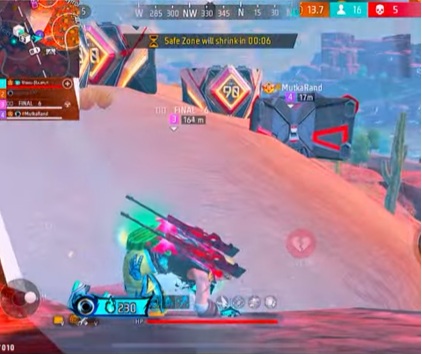
Free Fire does use skill-based matchmaking, but it’s intentionally lightweight, not strict.
Instead of relying only on K/D or win rate, the system likely considers:
Rank and progression
Recent performance trends
Match frequency and activity
Possibly device or network stability
Why keep SBMM loose?
Strict SBMM on mobile often causes:
Long queue times
Cross-region lag
Constant high-pressure matches
Free Fire prioritizes fast queues and smooth play over perfectly balanced lobbies.
As players win more, improve consistently, and climb ranks, the protection fades.
That’s why many players feel a sudden difficulty jump after strong streaks.
The system is testing readiness—not punishing success.
Player Protection Supports Retention—Not Pay-to-Win
A hard truth of game design is this:
Players don’t spend—or stay—if they’re constantly losing.
Free Fire’s matchmaking helps players enjoy:
Progression
Characters and skins
Events and ranked play
This is why Free Fire top up behavior usually happens after players feel comfortable, not immediately.
Importantly:
Spending does not affect matchmaking difficulty
High ranks still require real skill
Competitive modes remain challenging
The system protects the experience, not the wallet.
Final Verdict: Yes—but With a Purpose
So, does Free Fire protect low-skill or new players?
Yes.
But only temporarily—and for a reason.
It gives players time to learn, improve, and stay engaged before raising the challenge level.
That balance between accessibility and progression is a major reason Free Fire became one of the most played mobile games globally.
Free Fire doesn’t punish players for being new.
It lets them grow—at their own pace.

- 100+10 Diamonds$0.82-$0.15$0.97
- 310+31 Diamonds$2.46-$0.43$2.9
- 520+52 Diamonds$4.11-$0.73$4.84
- 1060+106 Diamonds$7.81-$1.38$9.19
- 2180+218 Diamonds$15.56-$2.75$18.31
- 5600+560 Diamonds$39.09-$6.9$45.99
- Weekly Membership$1.79-$0.32$2.11
- Monthly Membership$8.61-$1.52$10.13
- Booyah Pass card$3.18-$0.56$3.74
- Weekly Lite$0.42-$0.07$0.5
- Jovial Symphony King Bundle$4.56-$0.8$5.36
- Queen Joyful Melody Bundle$4.56-$0.8$5.36